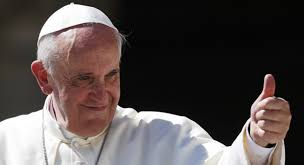
The Pope: A Genius CEO

Pope Francis - Thumbs Up

A couple years back, shortly after becoming Pope, Francis began changing the way finances were managed at the Vatican.  I wrote back then that I thought that was an important move, not only because it was prudent management, but because of the “optics” he was creating by taking advantage of skill sets from within the laity.  One of those optics was transparency.  While it didn’t put the financial condition and management processes on the web for all to see, it did breakdown some of the clericalism that tends to both obscure bad practice and insulate the institution from change.  Involving prominent, talented lay people, helps promote the understanding that their is meaningful openness developing.

Now the Pope is calling for dirty money to take their business elsewhere.  By publicly coming out with this stance, the Holy Father is doing more to devolve that closed door feel to the universal church.  This Catholic spreads a consistent message of who comes first.  It’s the poor.  By telling the dirty money to stay away, he is telling the oppressed that their backs won’t be used to prop up the organization founded to spread the good news.

This isn’t transparency per se.  It is a direct statement to those in opposition to the mission of the church, but the more important message is to those within the church.  We don’t need them, we have God.  We are open to what is good and will fight to keep evil at bay.  The poor and the just, that is our Church.  The organization of the church should support that message (the Good News).  That is marketing.  Marketing is evangelization.  Like all great CEOs, he is the organization’s chief sales officer.

Pope Francis is remarkable.  He is a force for good (all due respect to the U.S. Navy).  He is always “on message”.  He never shies away from what is right.  He is effective.  The world needs more CEOs like Pope Francis.

Imagine More

John Flett wrote a good piece on LinkedIn recently on imagining better as an important precursor to business success.  I agree with his assessment.  However, I wasn’t to the end of the first paragraph when I began to think about the lack of imagination in the operation of the Church.

All I say within these “pages” should be understood to come from someone deeply committed to the one true, universal church.  This attestation notwithstanding, I think it obvious that the humans are the problem.  And humans in charge are the biggest problem.

The fact that the Catholic Church changes slowly is, on the one hand, a virtue.  It demonstrates a two thousand year history of deep, thoughtful discernment (perhaps that is redundant). On the other hand, however, I have witnessed a significant reluctance to all change in the Catholic hierarchy over the years.

I’m not a theologian.  So even if I thought that church teaching should change, I would be unlikely to advocate for it.  I am, however, a strategist. And the kind of change  most needed in the Church is strategic.

There is far too much sentiment from both the laity and the clergy that is reactionary; that says we should somehow return to practices of the past; that tries to hold tight to existing structure.  This grip on the past has more downsides than up.  Most importantly, it blocks our collective imagination.  It breeds frustration.

A couple years back I wrote about the opportunity that Pope Francis is providing to the local Church (dioceses and parishes).  The opportunity is for structural, methodological change- not dogmatic, theological change.  Were we, at the local level, to follow the Holy Father’s lead, we would grow the faith dramatically.

Unfortunately, I have seen little evidence in the last two years that suggests that we are prepared at the local level to make those changes.  We are lacking in imagination.


Design a site like this with WordPress.com
Get started